
When the budget, priorities, or direction keep changing, planning can feel pointless. It is not. Here is how to keep marketing moving and learning when you do not yet know the right path.
We have written a lot about planning. Clear objectives, tactical plans, phased roadmaps, budgets built from the ground up. All of it assumes something that is not always true: that you know where you are going.
In real growth companies, that assumption breaks constantly. The budget gets cut or doubled halfway through the quarter. A new product direction appears. A big customer shifts the priorities. Leadership changes its mind about the target market. Marketing planning under uncertainty is not a special case you handle once. For most growth companies, it is the norm.
So how do you plan marketing when priorities keep changing, and the direction itself is unclear? The wrong answer is the most common one: wait. Pause the activity until things settle, until the strategy is clear, until someone decides. The problem is that standing still teaches you nothing, and the situation rarely gets clearer on its own.
Standing still is the most expensive option
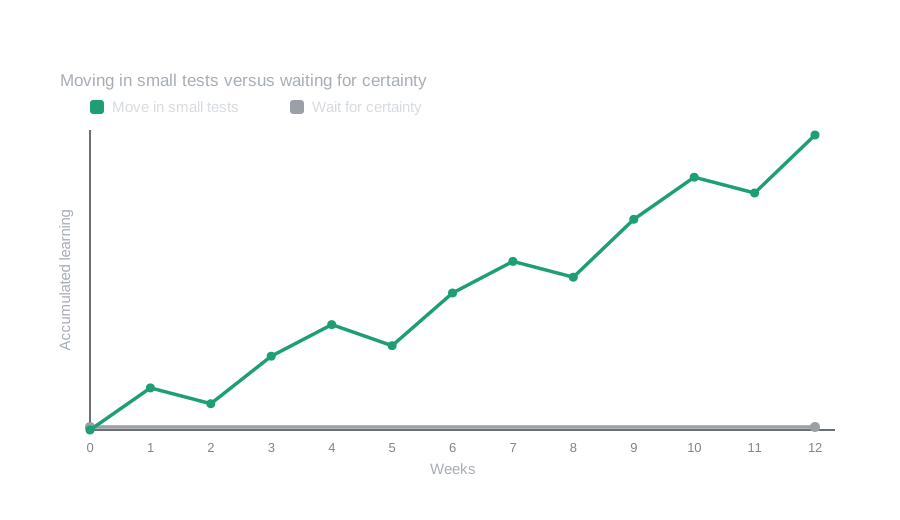
There is a principle at the core of lean thinking that applies directly here. If you do not know which way to move, it is still better to move somewhere than to stay in place. Staying still feels safe because it avoids the risk of moving in the wrong direction. But it guarantees the one outcome you cannot afford: no learning, no data, no progress.
Movement produces information. A campaign that underperforms tells you something about the audience, the message, or the channel. A test that fails removes one option and points you toward the next. This is the core of lean marketing experimentation: you do not need to know what works in advance, you need a fast, cheap way to find out. Standing still produces nothing but a later start.
This is not an argument for acting randomly. It is an argument for treating action as the way you resolve uncertainty, rather than something you postpone until the uncertainty resolves itself.
Keep the objective, loosen the plan
Knowing how to market when you do not know what works starts with a distinction: the objective and the plan are not the same thing. Moving under uncertainty does not mean abandoning objectives. It means holding on to them more tightly than ever, while holding the plan more loosely.
Even when the direction is unclear, there is almost always a stable objective underneath the noise: More qualified pipeline. A validated new segment. Lower cost per acquisition. The specific campaigns and channels may need to change every few weeks, but the objective they serve usually holds. When priorities shift, you do not throw out the objective. You change the route to it.
This is the difference between a plan and a direction, and it is the foundation of agile marketing planning. A rigid plan breaks the moment conditions change. A clear objective with a flexible plan bends and keeps working. The teams that struggle most under uncertainty are the ones who confused the two, treating a specific set of tactics as if it were the goal itself.
Make the steps small enough to be wrong
When you are confident about direction, you can commit to large, long campaigns. When you are not, the smart move is to shrink the size of each bet.
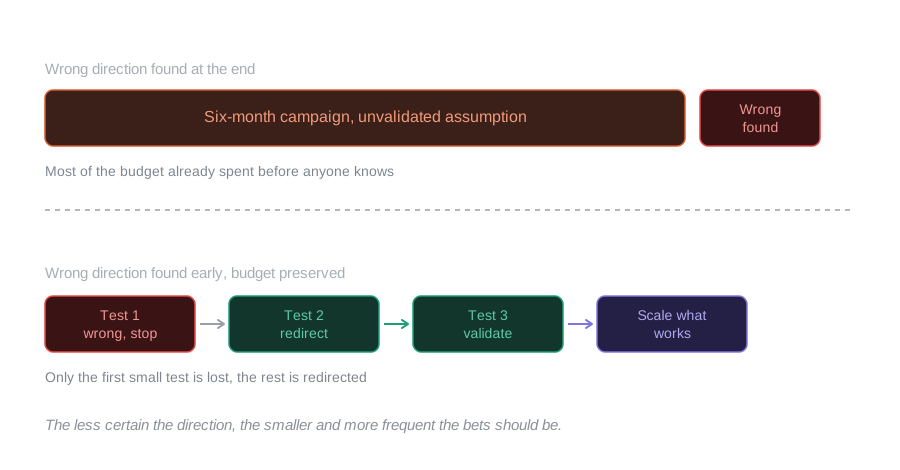
Smaller, faster actions have a specific advantage under uncertainty: they let you be wrong cheaply. A two-week test that fails costs little and teaches you something. A six-month campaign built on an unvalidated assumption can waste a large share of the annual budget before anyone knows it was aimed in the wrong direction. This is also how marketing planning with a changing budget becomes manageable: small, self-contained experiments are far easier to start, stop, or scale when the money moves than large commitments are. The less certain you are, the smaller and more frequent your experiments should be.
Each small step either validates the path or rules it out, and both outcomes are progress.
Document what you learn, or the movement is wasted
Movement only beats standing still if you actually capture what each step teaches you. Otherwise, you are just busy.
This is where structure matters most under uncertainty, not less. Every test needs a defined objective before it runs, and a recorded result after. When the direction is changing, this documentation becomes the map you are drawing as you go. Six weeks of small experiments, each with a clear result, will often tell you more about where the business should focus than any amount of upfront strategy debate. The learning compounds, and the direction that seemed unclear at the start begins to define itself through evidence rather than opinion.
Uncertainty is the normal condition, not the exception
It is tempting to treat uncertainty as a temporary disruption, something to endure until normal planning resumes. For most growth companies, it does not work that way. Marketing planning without a clear direction is not a failure of planning. It is the condition you plan inside of. The direction is almost always somewhat unclear, the priorities almost always shifting. Waiting for a stable, certain environment to plan properly means waiting forever.
The companies that market well under these conditions are not the ones with better forecasts. They are the ones who made peace with moving before they had certainty, who kept their objectives clear and their plans flexible, and who treated every action as a way to learn something. They move, they measure, they adjust, and they move again. And while their competitors wait for the fog to lift, they are already finding the way through it.
At Aboad, we help growth companies keep marketing moving and learning, even when the direction is still taking shape. If your plans keep colliding with a changing reality, we are happy to talk.
Discover related content:
What Is a Tactical Marketing Plan, and Why Is It So Important?
How to Develop a Marketing Plan Utilizing the OKR Model