
What if your company could change over the next two years so it fits the operating environment of that time as well as possible, and creates the most value because of it?
To make that possible, you need a clear picture of what the future may look like. That picture should come from analysis, not guesswork.
When we analyze and shape a company’s strategic direction, we focus on two areas:
- the company itself
- everything around it
The external world is often split into smaller parts, but it is better to see it as one connected ecosystem in which the company operates. We can fully control our own actions. We can only partly influence everything else, and often not at all. What we can always do, however, is prepare.
Commercial Megatrend Analysis looks at megatrends broadly
Many companies monitor megatrends, especially the ones directly tied to their own industry. Commercial megatrend analysis takes a step further back. It looks at the wider operating environment and its activity, broadly enough to understand the full context.
The purpose of the analysis is to:
- identify the megatrends that shape the external operating environment, both directly and indirectly
- translate those trends into a near-future view of what may happen
- bring the insights into practical company actions
Indirectly affecting megatrends are especially important to highlight, because they are easy to miss and therefore often forgotten.
Stages of Megatrend Analysis
We do the analysis and research in phases. We start with a broad area, such as digital marketing in our case, and then narrow it down step by step until it becomes concrete and relevant to the specific context.
The example used here comes from our digital marketing future report.
1. Defining megatrends and impacts for a 3–5 year period
In the first stage, you study the megatrends that affect your company’s operations. These can have direct or indirect effects. They can range from regulation and economic development to changes in customer behavior.
You can usually find ready-made analyses and reports from public institutions and private research organizations. Use them as core sources, and then add your own data and observations.
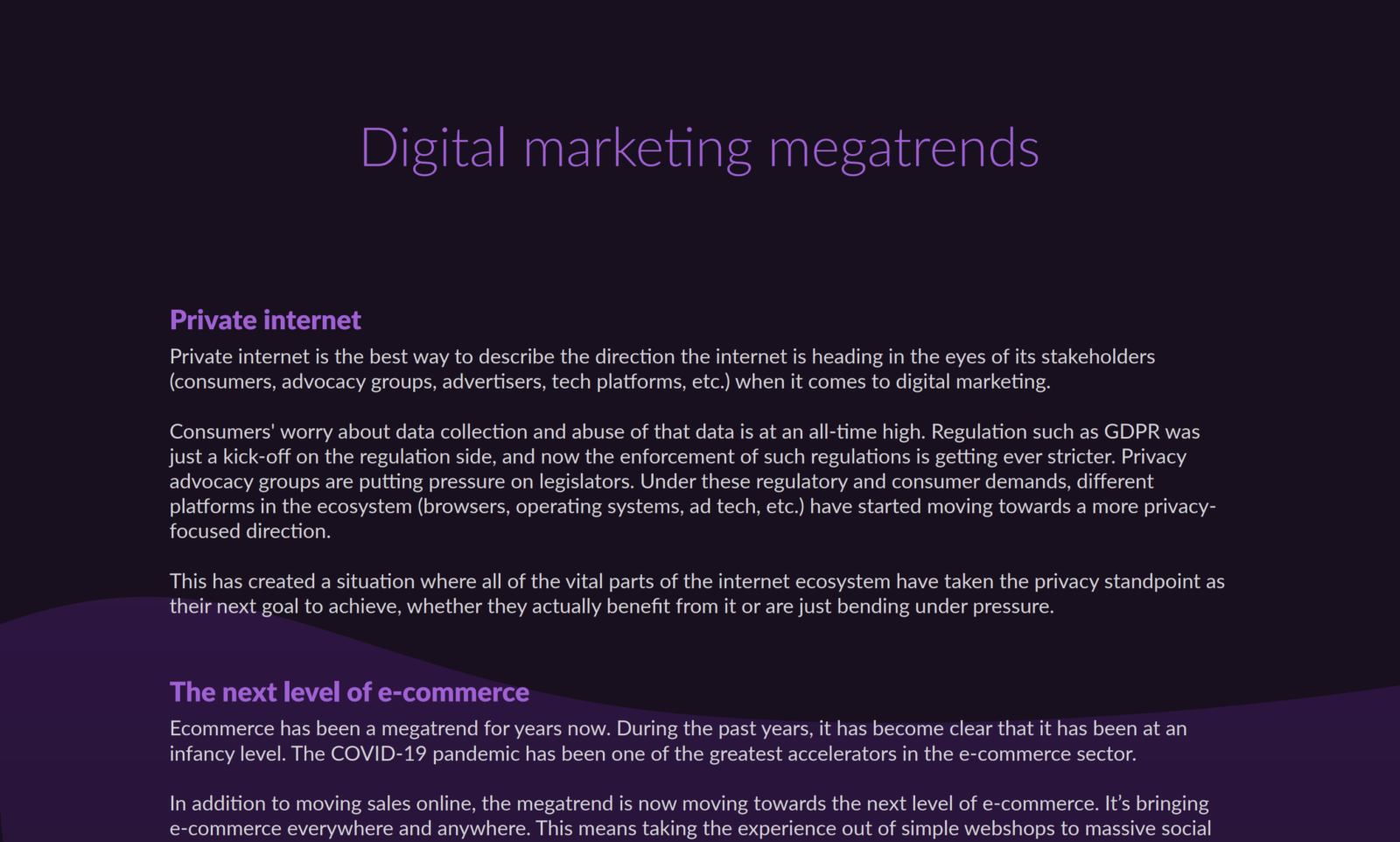
For example, our future report has monitored trends affecting the industry, from the latest pandemic to data responsibility and the increasing vertical integration of technology platforms.
2. Combining and contextualizing megatrends into scenarios
Once you have selected the relevant megatrends, the next step is to combine them and build scenarios for the coming years. The goal is to understand how the trends interact and what concrete changes they may cause in your operating environment.
A useful outcome is that you often find scenarios where the combined impact of trends pushes development in a direction that differs from what people normally assume.
For example, the privacy-focused “Private Internet” megatrend can increase the power of technology companies when combined with the megatrend of vertical integration. This helps us see two things at the same time:
- platforms may become more like isolated islands
- privacy legislation may unintentionally accelerate this direction by strengthening the conditions that favor walled gardens
In other words, the Private internet trend can partly weaken its own goal by creating outcomes that work against it.

3. Planning strategic actions for the next 3–5 years
After you have built a clear picture of what the operating environment may look like in the coming years, you can define strategic guidelines for how the company should respond. The aim is to reduce negative impact and increase positive impact. This makes strategic planning more research-based and less driven by assumptions.
4. Building a roadmap for the next 12 months
Planning has no value if it does not lead to action. That is also the point of this framework. The work needs a bias toward action.
The roadmap will look different depending on what you sell and what your analysis reveals. The key is that it turns the strategy into a concrete set of priorities and steps.
5. Monitoring, updating the picture, and implementing
The horizon keeps moving, whether you think of it in terms of distance or time. In strategy work, monitoring is essential, both for the future vision and for the earlier stages (1–4).
Monitoring typically happens in cycles of six months to a year. In each cycle, you review:
- whether development has followed the scenarios
- whether the pace and direction of change have become clearer
- whether the future vision needs to be adjusted
Personal experiences using megatrend analysis
Megatrend analysis is a tool I use whenever a strategy needs to go beyond the next year. One year is usually too short a time frame for this kind of work.
Commercial megatrend analysis helps create a better understanding of what may happen and what direction the company needs to develop. The business environment often feels like a changing labyrinth. By the time strategy work produces results, the world can look very different from what it looked like during planning.
When we use this approach with clients, we combine megatrend analysis with future modeling. We also add industry-specific megatrends to make the output more relevant. This creates strong results while requiring far fewer resources than building a full future model from scratch.
Also read:
Strategic Moats Defend Your Business in Competitive Markets
Future-proofing marketing
Aboad Future Services