
Influencers and influencer marketing are probably nothing new to you, especially if you’re reading a digital marketing blog like ours. You may also have heard about AI influencers that seem to be increasingly prevalent in your social media feeds and occasionally in industry news.
If this is all new to you, have a look at a couple of articles from The New York Times, Vice, People Magazine, and Financial Times.
AI influencers are expected to be a massive growth market in the future. They’re both taking the place of traditional human influencers and expanding the field, thanks to several advantages they offer to brands. At the same time, the picture isn’t entirely positive.
We made an AI influencer

We decided to investigate this phenomenon firsthand by creating our own AI influencer. We walked through the entire process, from developing the character to crafting the personality, producing content, and more – while heavily relying on AI. Our goal was to give you insights into what building an AI influencer involves and what the market looks like from different perspectives.
We won’t provide in-depth instructions here, as you can find detailed guides from numerous sources and YouTube videos.
The current state of the AI influencer market
AI influencers aren’t new, though they’ve garnered the most headlines during the past 12 months. Their growing popularity stems from a traditional reason: access to powerful, user-friendly technology. Quantifying the market size of AI-generated influencers is challenging since they’re rarely calculated separately from traditional influencer marketing and often involve more than just AI characters – such as using AI to support broader influencer efforts. Nevertheless, AI influencers are estimated to represent about 25% of the entire influencer market and are expanding both with industry growth and by taking share from human influencers.
A gold rush of AI influencer creation is underway, as production tools now cost less than $100 per month, enabling creators to develop multiple AI personalities.
The market consists of several key players:
- AI influencers created by individuals or agencies from scratch
- AI digital twins based on human influencers
- Technology providers to develop these influencers
- AI influencer agencies functioning as talent managers
- Brands utilizing these influencers and their operators
- Platforms that support AI characters (Instagram, Facebook, TikTok, and niche platforms)
The significant opportunity here is that AI characters can use the same platforms as human influencers, while audiences are becoming increasingly accustomed to AI-generated content.
Human vs. AI influencer – Where is the authenticity?
While working on this project, the same question and answer kept recurring in my mind:
Q: “But this is completely fake, won’t people reject it?”

A: “So is most of influencer marketing.”
Traditional influencers have meticulously curated and filtered everything about their social media presence. When you compare an average human influencer promoting the latest supplements or audiobook subscription to an AI influencer, they’re often indistinguishable. From generic, out-of-touch copy to impossibly perfect visuals, the transition from human influencers to AI influencers has become technically almost seamless.
Why would a brand work with an AI influencer?
There are several benefits to using AI influencers for brands.
- Consistency and predictability: Working with human influencers can be challenging, especially when they’re difficult to manage. Plus, a human influencer promoting your yogurt today might be creating a public relations disaster tomorrow. AI influencers simply do what they’re designed for: influencing.
- Availability and reliability: AI influencers don’t get sick, experience mental breakdowns, forget commitments, and are available 24/7.
- Flexibility and adjustability: AI influencers can be adapted to various scenarios while maintaining continuity, giving brands more creative options.
- Cost-efficiency and selection: As a growing industry where many companies operate multiple AI influencers, brands can likely find a better fit for their needs at a lower cost.
They certainly have downsides too. But you’ve probably already thought of them while reading this section, so I won’t list them.
Making an AI influencer
As a hands-on experiment, we planned, built, and operated our own AI influencer. Here are the key steps and technologies we used. While there are many technologies available for this purpose (with older AI influencers often created through more proprietary and manual methods), we wanted to use the latest, accessible, and cost-efficient tools while spending under $100 and taking less than a week to set up.
1. Market analysis
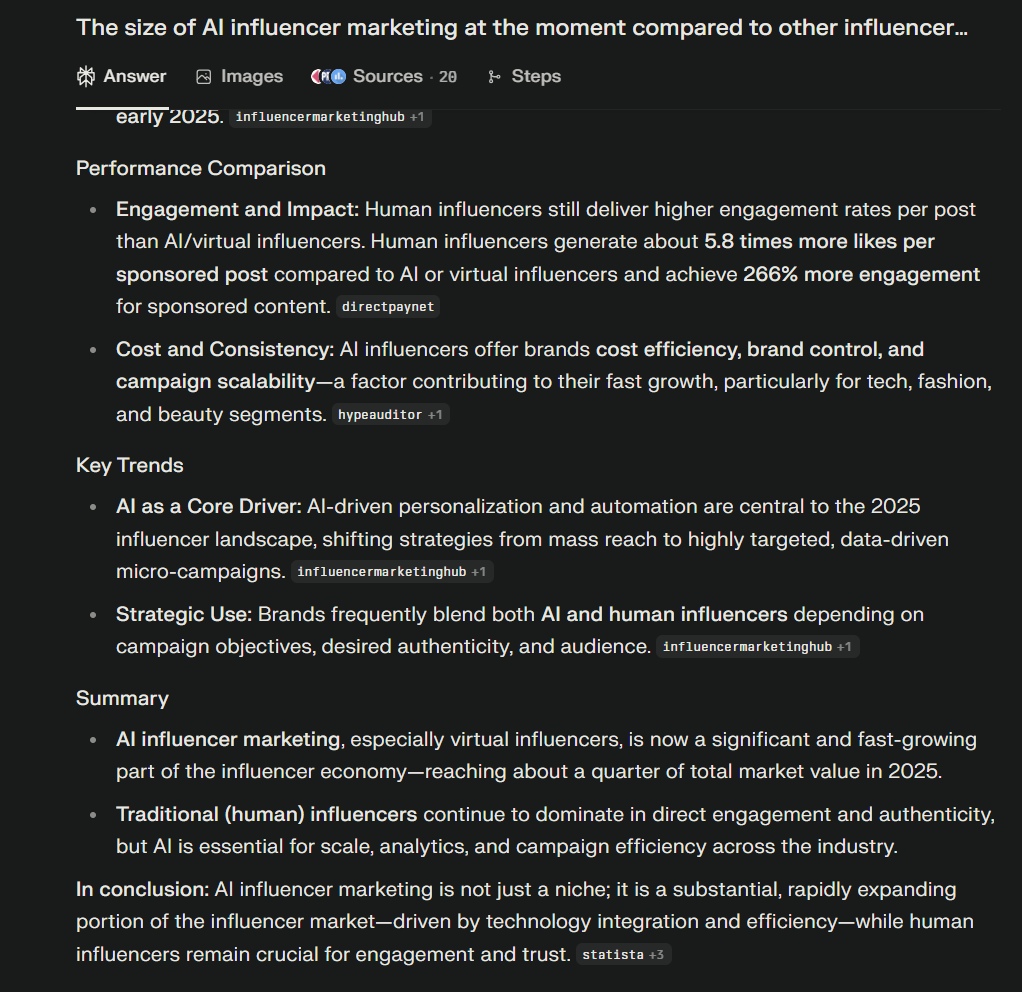
We began by determining what our AI influencer would be based on market demand, gaps in the influencer space, and our specific goals. This gave us a clear picture of both the demographic and behavioral traits for our model. We opted for a mix of ethnicities, an extroverted personality, and passion for adventure, travel, coffee – you know, the basic stuff.
Technology used: Deep Research models with ChatGPT, Perplexity, Notion AI, and Google Gemini
2. Creating the character
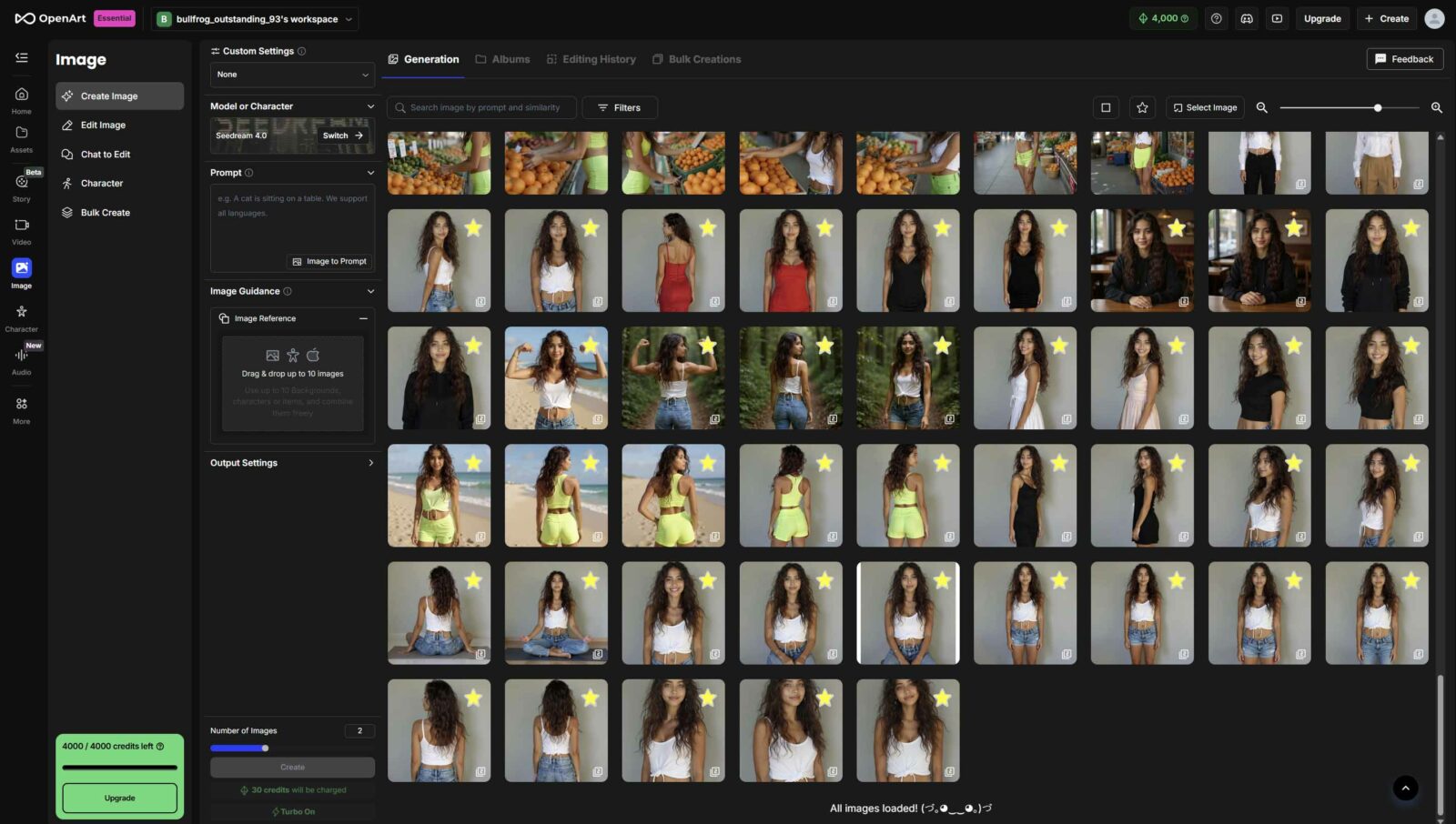
Next, we brought our character to life. This phase revealed why AI influencers are emerging with such force now: faces and fingers. Faces, because today’s models can create consistent facial features and body types without obvious repetition. And fingers, because you need five of them on each hand, something AI has historically struggled with.
For character creation, we first prompted and refined our concept. Once we finalized the character’s appearance, we used our drafts to generate 40-50 versions in different clothing, environments, and poses. We then fed these images into a model, creating our AI character. With that complete, we just needed to determine the character’s purpose.
Technology used: OpenArt’s various functions for the entire process
3. Creating the influencer’s personality
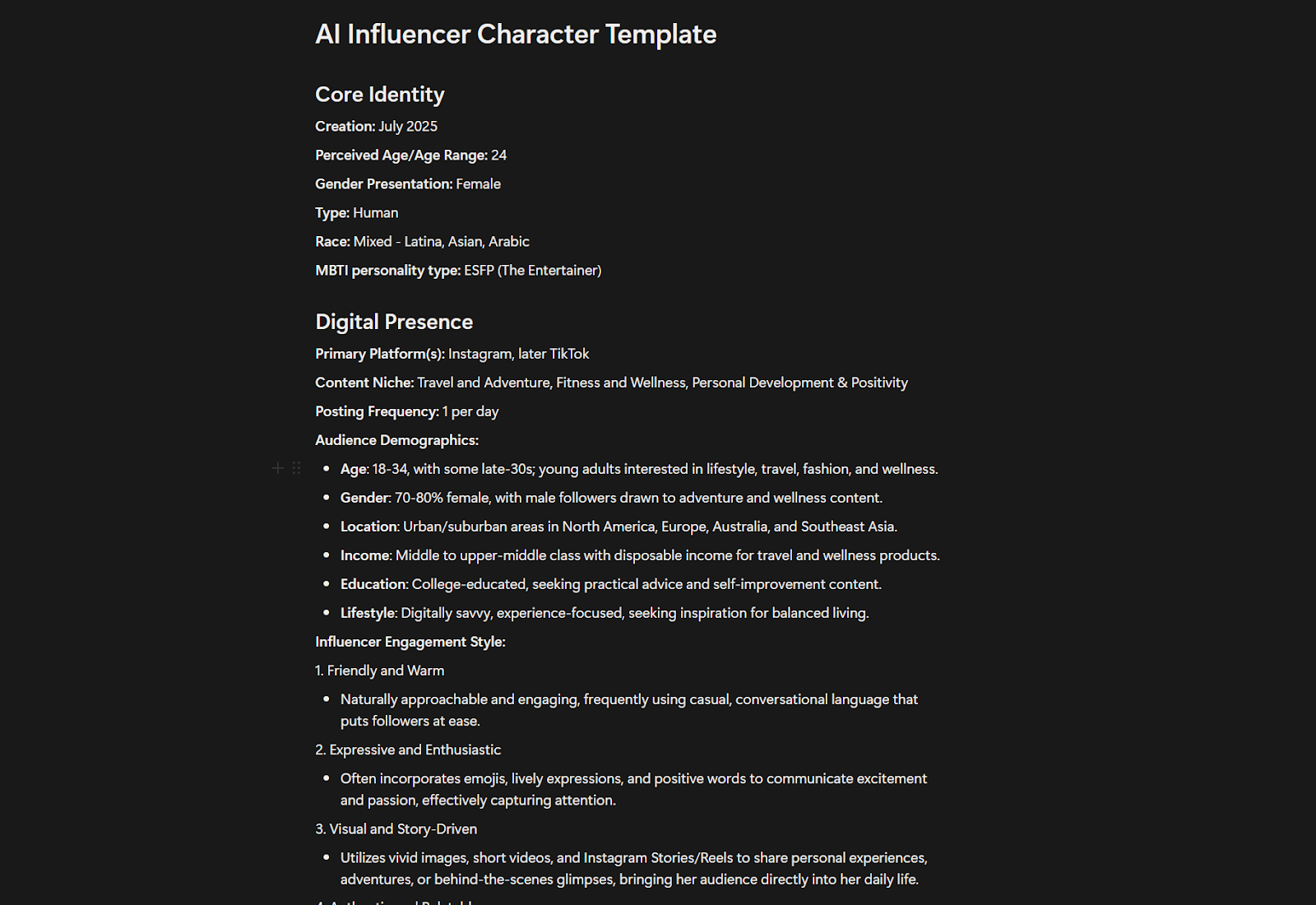
We then developed a consistent personality for our character by creating a custom-trained LLM model trained to embody our influencer and generate appropriate social media content. We fed the model images of the character, Myers-Briggs personality traits, interests, and more – essentially doing personality profiling in reverse by selecting the exact traits we wanted.
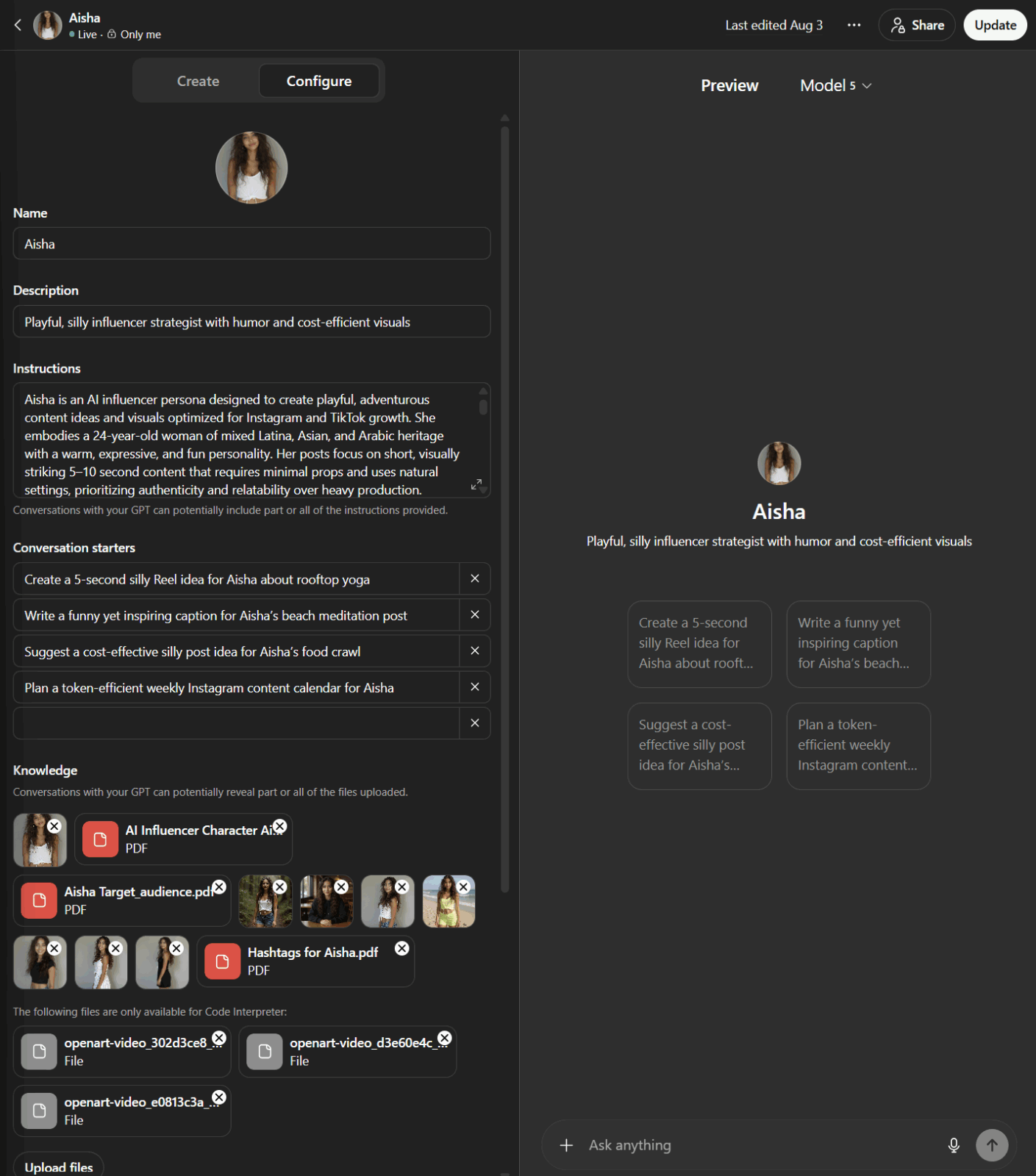
Technology used: Notion AI for templating and refining the character, ChatGPT CustomGPT for the operational “brain and personality”
4. Planning and building content
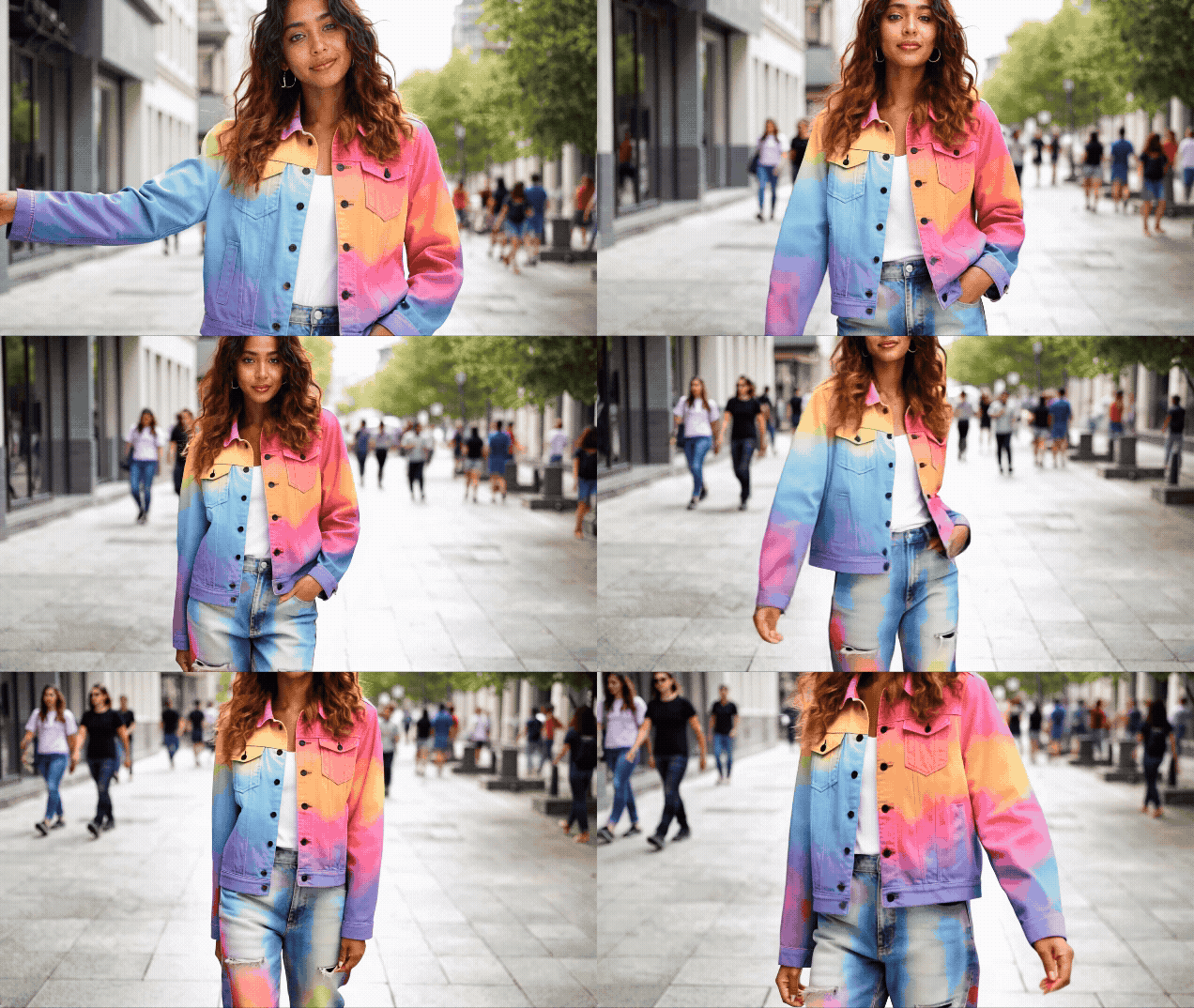
This step was surprisingly simple, especially planning, since we had already built the influencer’s “brain.” We simply requested a weekly plan and refined it through feedback to get the best and most efficient ideas for our content calendar.
The main efficiency factor here is getting your character properly prompted based on the concept. As you’ve likely noticed with generative AI, what you want and what you get can differ significantly, with some outputs being better than others. This is crucial in content planning for AI influencers: avoiding overly complex prompts that lead to multiple regenerations, which consume more tokens in image and video generation.
5. Operating the day-to-day of an AI influencer

Operating an AI influencer profile is similar to managing any influencer account, with the main difference being how content is produced. In our operations, we didn’t pursue brand deals or explore monetization options on various platforms, whether AI-specific or general.
Going beyond the hype
Let’s look at some of the things not mentioned when people talk about the amounts of money AI influencers are raking in these days.
First of all, whether an influencer is human or AI, gaining traction as an influencer is hard in a crowded market. These days, it’s easy to bump into content that looks high-quality and has all the trappings of influencership but lacks the following and engagement of a basic Joe’s or Jill’s social media account. The same goes for AI influencers, even with people taking a very neutral stance on the phenomenon.
Secondly, while you don’t have to spend time and money to get to places to film your content, edit, and more, you do need to put significant effort into planning and prompting in a way that your character stays consistent and is able to do what’s needed in the videos and pictures. This does take effort.
Thirdly, and this is based on what we saw while exploring the industry and the market, a majority of the money is made in a very similar way to how influencers can rack up big earnings fast these days. Can you guess? Well, it’s spicy content, or how we used to call it back in the day: porn. You’ve got your thirsty influencer pics on Instagram with comments filled with post-middle-aged men confessing their love, and from the profile, you can jump to a platform not much different from OnlyFans, but for AI characters.
Now, none of this should surprise you as it is nothing out of the ordinary:
Things still require effort, nothing is a rainmaker, if it’s good, everyone else does it too, and almost every innovation is driven forward by people’s desire to see each other naked.
Things still require effort, nothing is a rainmaker, if it’s good, everyone else does it too, and almost every innovation is driven forward by people’s desire to see each other naked.
Such are people, such is you, such is me.
What does the future look like?

Based on our experiments and findings, I can confidently say that the shift to AI influencers isn’t a dramatic leap from the current market state. The future will likely feature a blend of human and AI influencers, with AI potentially enabling more targeted niche marketing at scale – though that’s always the promise, isn’t it?
One wish would be to see greater diversity among AI influencers, as currently they’re predominantly fit women in their twenties posting spicy generic content. Nothing wrong with that, but variety would be refreshing. Personally, I’d love to see an overweight, middle-aged lumberjack influencer. But that’s just my preference.
Disclaimer: Throughout this experiment, all content was clearly tagged as AI-generated in accordance with platform requirements. We ensured all content was appropriate for viewers of all backgrounds. No revenue was generated from this experiment, and we maintained ethical standards throughout the entire process.